- What is Artificial Intelligence?
- Artificial intelligence (AI) is the field of computer science concerned with building systems that perform tasks normally requiring human intelligence — such as understanding language, recognising patterns, making predictions, and taking decisions or actions. In a business context, AI usually means software that learns statistical patterns from data and applies them to new inputs, rather than following hand-written rules for every case.
- What is Generative AI?
- Generative AI is a class of artificial intelligence that creates new content — text, images, code, audio or video — in response to a prompt, rather than only classifying or predicting from existing data. It is powered by large foundation models trained on very large datasets, and it is the technology behind Microsoft Copilot, ChatGPT, Claude and Google Gemini.
- What is Microsoft Copilot?
- Microsoft Copilot is Microsoft's family of generative AI assistants. Microsoft 365 Copilot is the version embedded in Word, Excel, PowerPoint, Outlook, Teams and SharePoint that grounds its answers in your organisation's own content through the Microsoft Graph, respecting existing user permissions and Microsoft 365 data protection commitments.
- What is ChatGPT?
- ChatGPT is a conversational AI assistant developed by OpenAI, built on its GPT family of large language models. Launched publicly in November 2022, it lets users hold a natural-language conversation with a model that can draft, summarise, analyse, translate, reason through problems, write code, browse the web and work with uploaded files. Business and enterprise tiers add administrative control and contractual data protections.
- What is Claude AI?
- Claude is a family of large language models and an AI assistant built by Anthropic, an AI safety company founded in 2021. Claude is designed around a training approach Anthropic calls Constitutional AI, which uses an explicit set of written principles to guide the model's behaviour. It is widely used in business for long-document analysis, careful drafting, coding and agentic workflows.
- What are AI Agents?
- An AI agent is a software system that uses a large language model to pursue a goal across multiple steps, deciding which actions to take and calling tools, data sources or other systems to complete them. Unlike a chat assistant that only returns text, an agent can retrieve information, update records, trigger workflows and hand work to a person for approval.
- What is AI Governance?
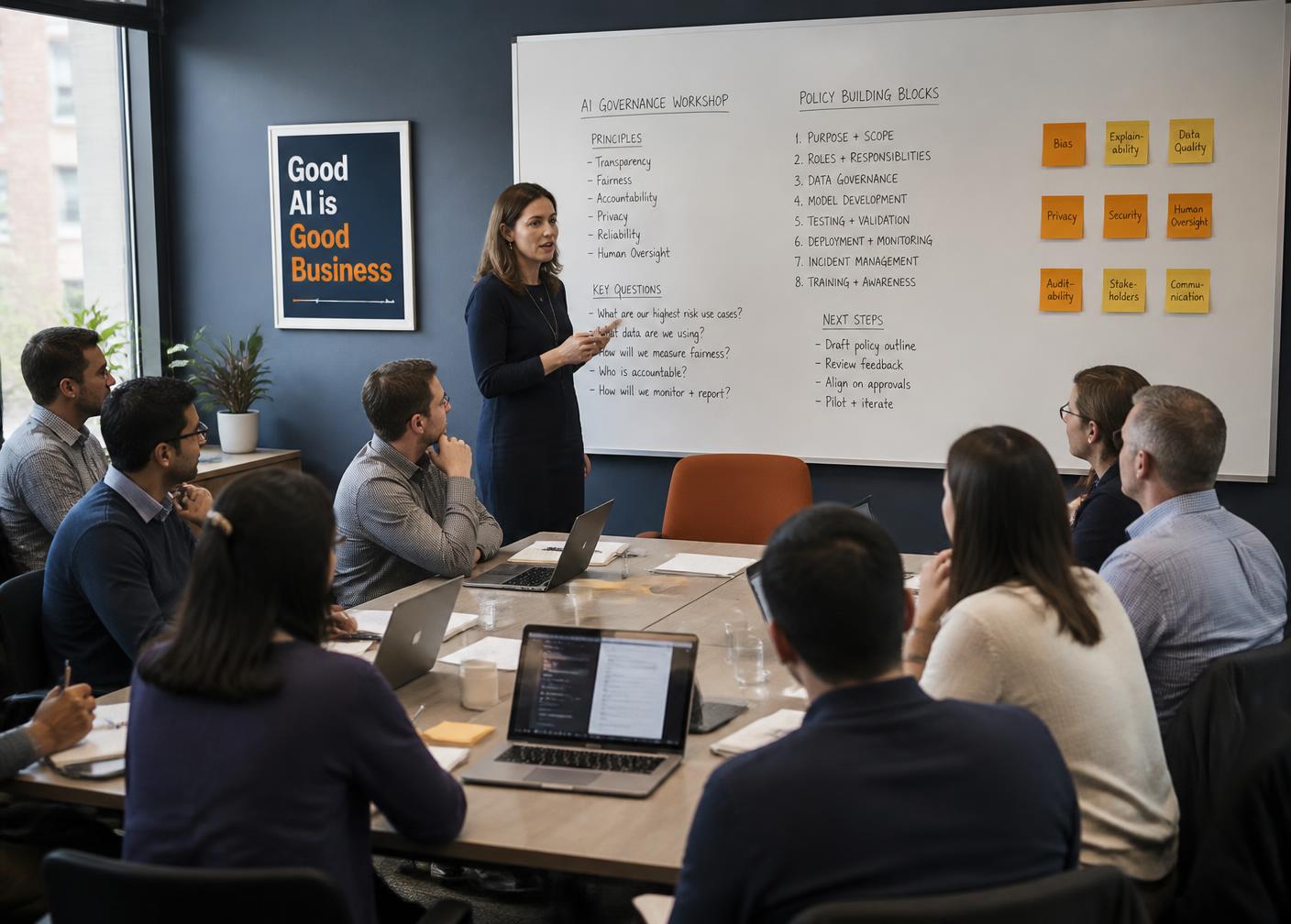
- AI governance is the set of policies, roles, controls and review processes an organisation uses to ensure its use of artificial intelligence is lawful, secure, accountable and aligned with its objectives. It covers which tools are approved, what data may be used, who is responsible for outcomes, how systems are assessed before deployment, and how use is monitored afterwards.
- What is an AI Usage Policy?
- An AI usage policy is a short internal document that tells employees which AI tools are approved, what information may and may not be entered into them, what must be checked before AI-assisted output is used, and who is accountable for the result. It translates AI governance into instructions an ordinary employee can follow without legal training.
- How can AI improve productivity?
- AI improves productivity by removing effort from repetitive, language-heavy and information-retrieval tasks — drafting, summarising, searching, extracting and reformatting — so that skilled people spend more of their time on judgement, relationships and exceptions. Gains are realised only where the tool is applied to a specific recurring task, users are trained on it, and time is measured before and after.
- How can AI improve customer service?
- AI improves customer service by resolving routine enquiries automatically, drafting and suggesting responses for agents, summarising conversations and history, routing work to the right person, and analysing every interaction for quality and insight. The strongest results come from AI that assists agents and handles the simplest contacts, with clear escalation to a human for everything else.
- How can AI automate business processes?
- AI automates business processes by handling the steps that previously required a person to read, interpret or decide — extracting data from unstructured documents, classifying and routing work, checking submissions against rules, drafting responses and deciding the next action — combined with conventional workflow automation that moves data between systems. The result is straight-through processing for routine cases and human review for exceptions.